Signal transduction in fluctuating environments
Incoming · Laboratory of Metabolism and Signal Transduction, EPFL
Cells perceive their world through signaling networks and set the pace of metabolism to
maximize their reproduction and survival. In my PhD work, we found that the conserved
Ras/cAMP/PKA pathway tunes the fraction of a yeast population that respires rather than
ferments — the two strategies for producing ATP from glucose. The pathway
distinguishes among carbon sources and their concentrations, and governs how yeast adapts
to changing nutrient levels.
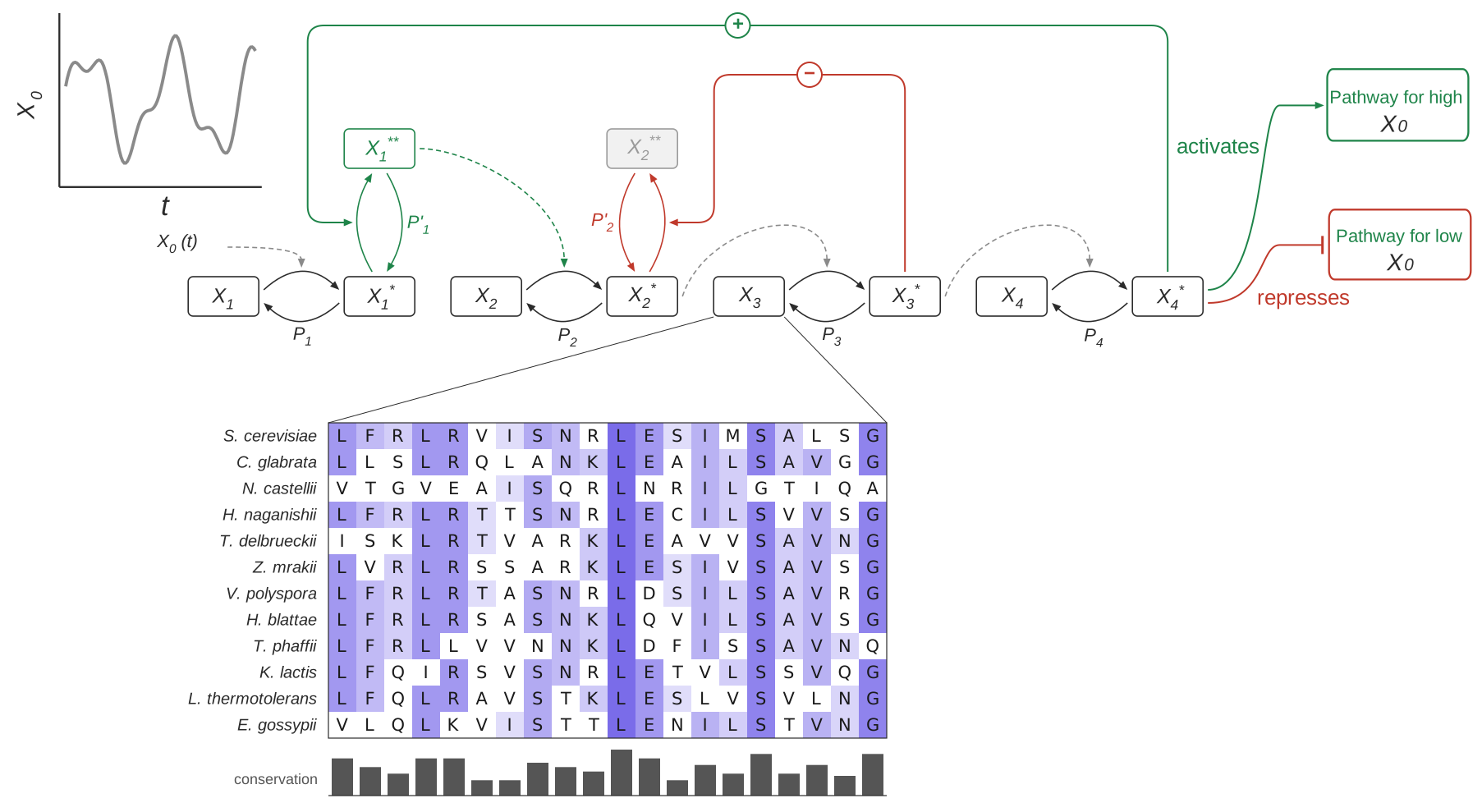
I became interested in how biophysical principles govern the way these signaling circuits
evolve to adjust dynamically to changing environments. Most signaling networks are built from the same parts — chains of kinase and
phosphatase cycles, wired together by positive and negative feedback. My lab will ask
how that wiring determines what a cell can sense when its inputs fluctuate, and how the
wiring changes as networks evolve. We are developing a framework that predicts the
response of a cascade with arbitrary feedback directly from its wiring, and testing it
with single-cell measurements in yeast.
Feedback control of single-cell energy metabolism
Incoming · Laboratory of Metabolism and Signal Transduction, EPFL
A fast-growing cell turns over its entire ATP pool in well under a second. That makes
energy metabolism acutely exposed to a glucose supply that, outside the lab, almost
never holds still — a tumor cell moving through heterogeneous tissue, or yeast
in a bioreactor, has to keep ATP stable while its environment swings. We understand
the fermentation–respiration decision fairly well for populations at steady state.
We understand much less about how an individual cell manages the transition.
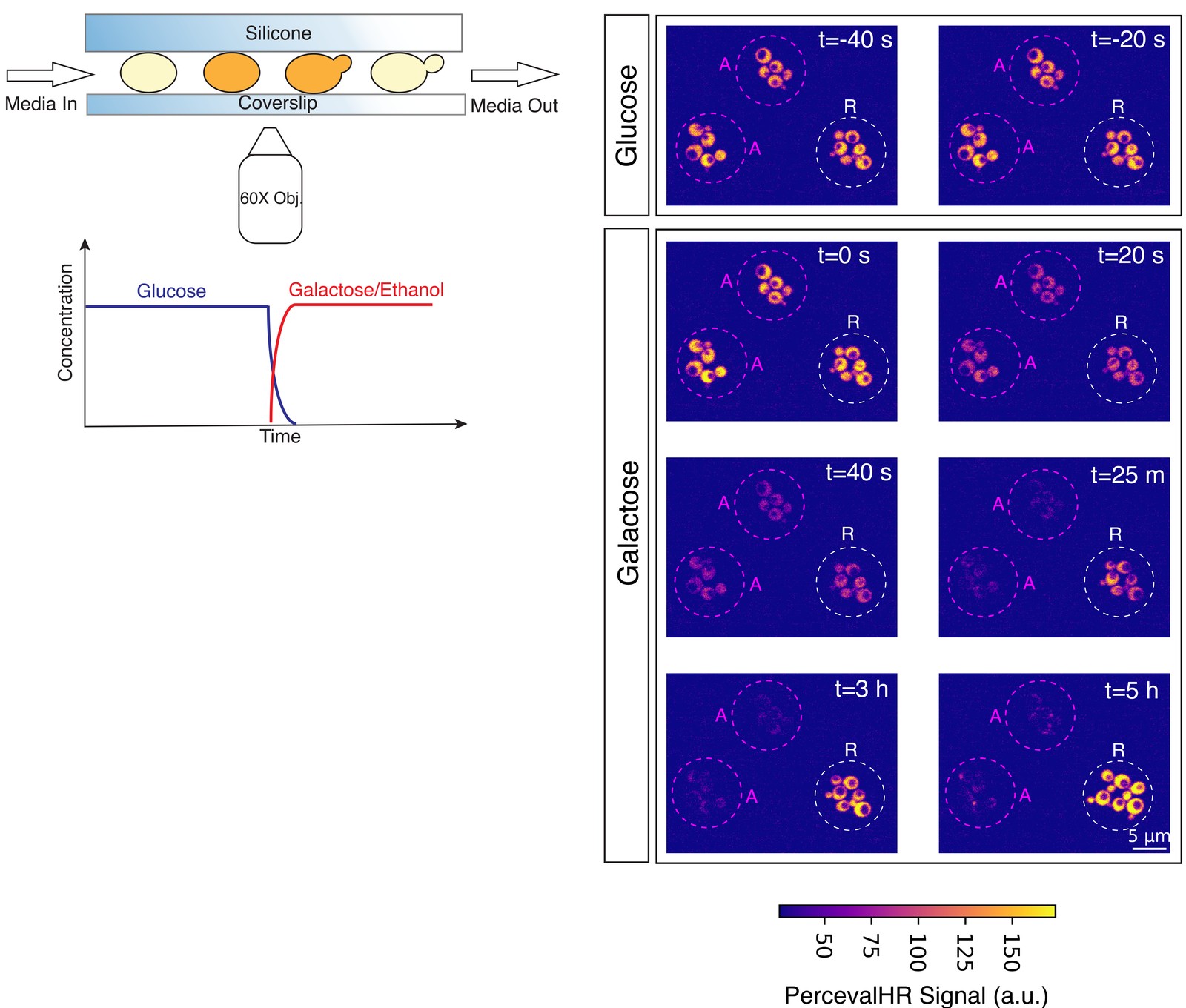
The group I am starting at EPFL will ask what a cell must sense in order to set
glycolytic flux that both maximizes growth and defends ATP levels. The approach is to
measure processes rather than components: calibrated biosensors imaged in single cells
from seconds to hours, combined with yeast genetics.
Three directions. First, the allosteric controls on phosphofructokinase — conserved
across the tree of life, yet removable with surprisingly little cost at steady state.
I suspect they exist to buffer ATP against fluctuation rather than to set mean flux.
Using these sensors, my group will test whether these allosteric controls buffer
ATP levels against stochastic glucose pulses in a microfluidic setup. Imaging at high
frequency and single-cell resolution will give new insight into the dynamics of energy
metabolism.
Second, the reverse direction: whether energy state feeds back onto the signaling networks
that are supposed to be reading the environment. Third, how mutations in those networks
reshape the glucose-in, ATP-out relationship, and what that does to fitness.
Metabolic bistability in yeast
PhD work · Murray Lab, Harvard · 2020–present
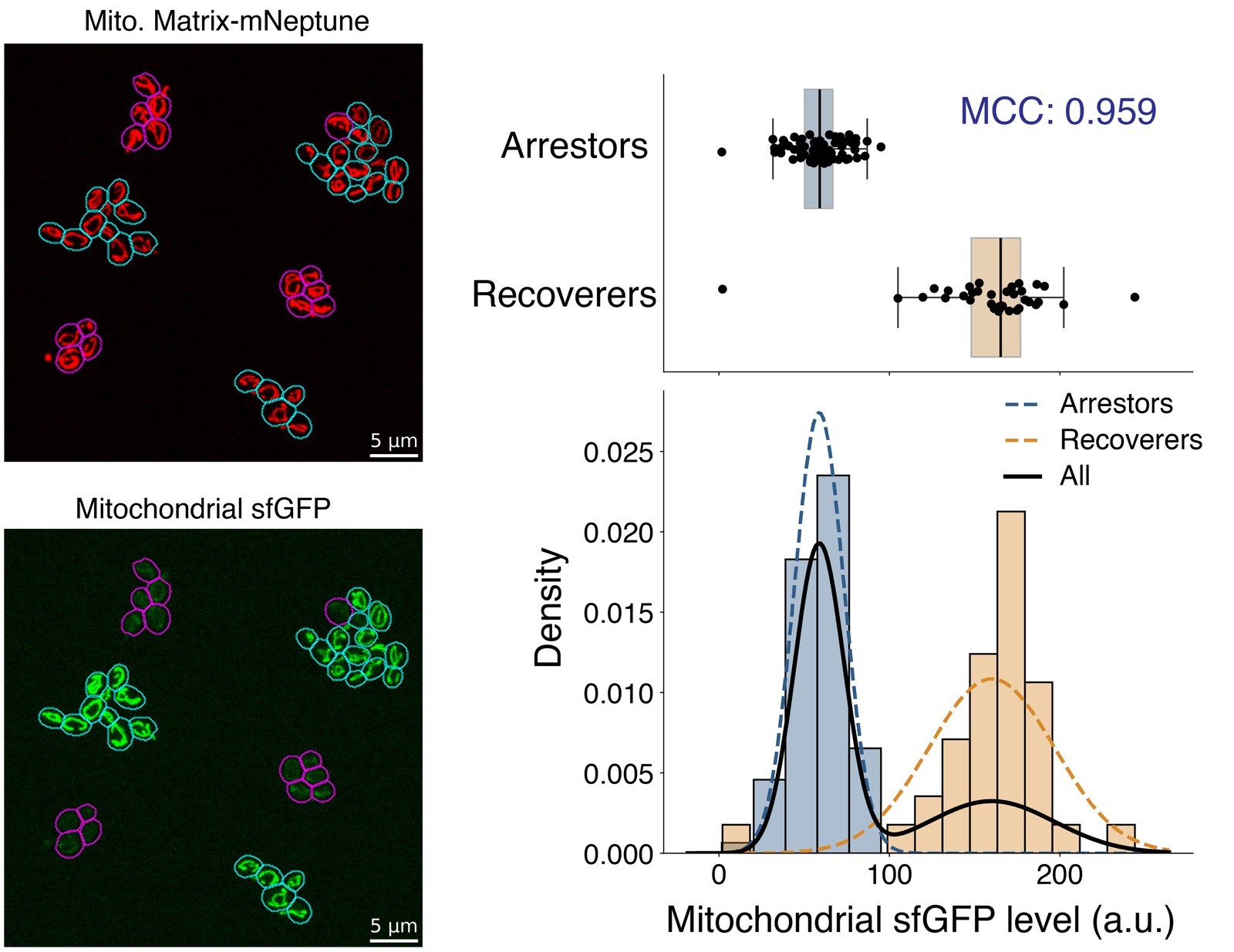
A clonal population of budding yeast is not metabolically uniform. Individual cells
settle into distinct, heritable states of energy metabolism — respiring Recoverers
and fermenting Arrestors — and stay there for many
generations. I combined single-cell metabolic imaging with physiological perturbations
to show that this split is generated by a bistable switch in mitochondrial activity,
driven by antagonism between cytoplasmic and mitochondrial translation.
Because the two states differ in how they fare when conditions change, the switch
gives the population a bet-hedging strategy: it pays a cost in average growth rate in
exchange for having some cells already in the right state when the environment turns
over. Alongside the experiments, I developed theory and computational pipelines for
tracking single cells and their metabolic state over long timescales.
preprint
From single cells to multicellular clusters
Murray Lab, Harvard · 2020–2024
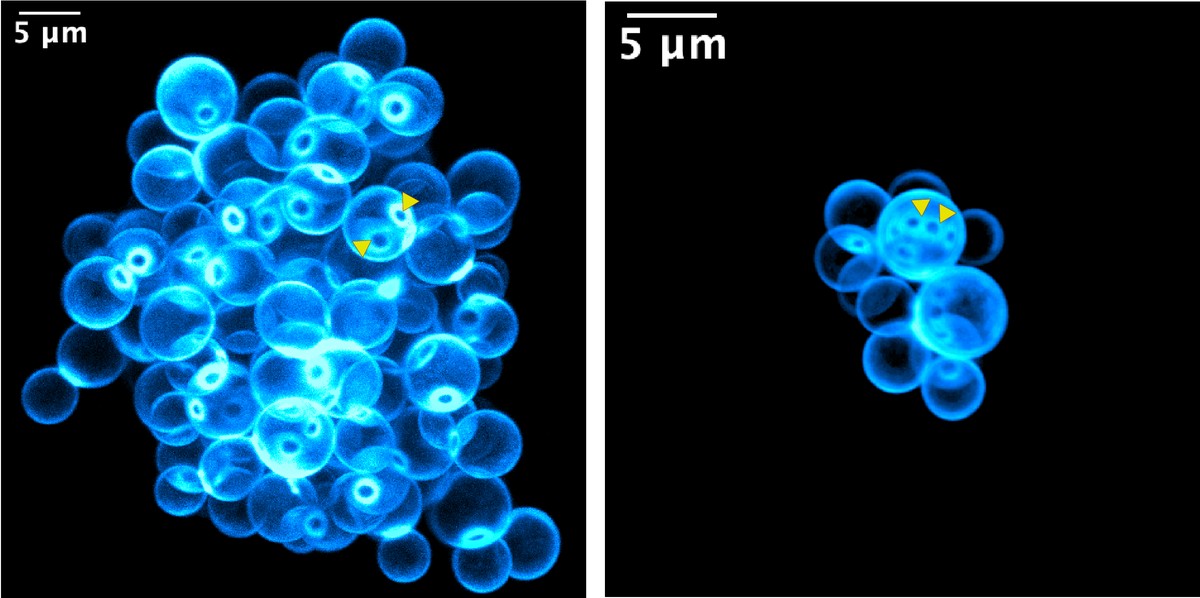
Snowflake-like yeast clusters form when daughter cells fail to separate from their
mothers. What sets the size and shape of the resulting clusters? I built a dynamic
network model that takes cell-level properties — budding geometry, bond strength,
division timing — and predicts the full distribution of cluster sizes and
compositions, then tested it against high-throughput microscopy measurements of
absolute cluster size.
Curr Biol 2024
Curr Biol Dispatch 2024
Genome-scale metabolic modeling
Metabolic Engineering Lab, IIT Kharagpur · 2018–2020
Metabolic networks are large and underdetermined, which makes it hard to say which
reactions actually change between two conditions. I designed Genome Scale–Differential
Flux Analysis (GS-DFA), a statistical framework that integrates genome-scale metabolic
networks with transcriptomic data to identify reactions whose flux is significantly
altered, and applied it to lung cells infected with SARS-CoV-2. The method has since been
widely used to infer differences in metabolic flux from transcriptome- and
proteome-constrained metabolic models.
Earlier, I reconstructed and analyzed a genome-scale metabolic model of
Lachancea kluyveri, a weak Crabtree-positive yeast, to understand how its
fermentation–respiration tradeoff differs from that of S. cerevisiae.
PLOS Comp Biol 2021
Sci Rep 2020
code